TTRU3 True Three-Phase Transformer Turns Ratio Tester
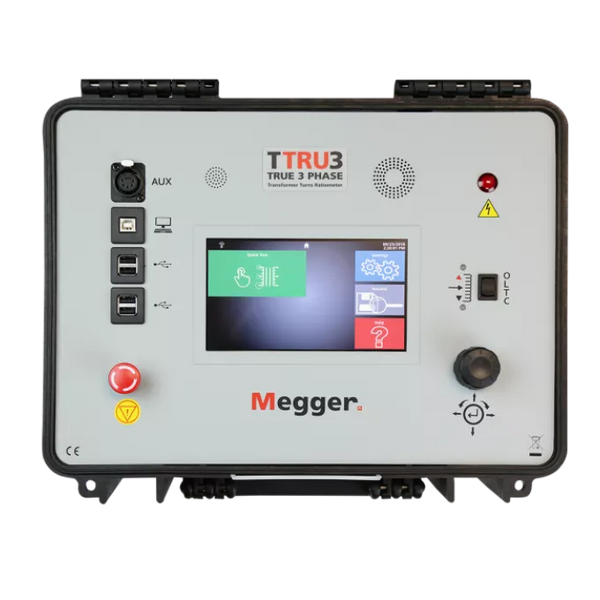
Megger’s TTRU3 transformer turns ratio tester is designed to perform three-phase turns ratio measurements using step-up excitation (patented). A single three-phase lead-set connection is all that is required to complete three-phase tests in less than 10 seconds!
The TTRU3 can induce up to 250 V on the primary winding, overcoming the voltage dependence seen on larger transformers. The three-phase source also allows you to test phase shifting and zigzag transformers and provides you with a guaranteed accuracy of ±0.05 % from -20 °C to +50 °C.
What’s more, the TTRU3 can be connected to a computer, enabling you to download results or control the instrument remotely. There is also an optional 2-inch printer for the instrument, enabling you to have a hard copy of your results if required.
Configure test plans and store results directly on the TTRU3 using the built-in 7-inch (18 cm) daylight-viewable touch screen display. To generate reports, results can be downloaded in Excel, and PDF files can be saved to a USB drive.
Last but not least, it’s also the smallest and lightest three-phase test set on the market!
The TTRU3 isn’t turning on
- Check that the power cord is fully inserted into the TTRU3.
- Check that the power source is outputting voltage at acceptable levels and frequency.
- Check that the power cord is fully inserted into the source.
- Check that the power switch is in the correct position ( I ).
- Set the power switch to off ( O ). Wait 30 seconds. Set the power switch to on ( I ).
- Try another power cord.
The TTRU3 reports “test failed”, but still provides data
- Check lead connections.
- Reference the nameplate to ensure leads are connected to the correct bushing.
The OLTC is moving in the wrong direction
Check the OLTC wiring diagram and ensure leads are connected to correct terminals.
Cannot connect the TTRU3 to a PC
- Contact your IT department for primary assistance when connecting any device to your PC
- Check the USB cable is fully inserted into the TTRU3
- Check the USB cable is fully inserted into the PC
- Check the TTRU3 is powered on
- Check the TTRU3 software is installed
- Check the TTRU3 software is not running in ‘simulation’ mode
- Check the TTRU3 is running
- Move the USB cable to another USB port on your PC
- Try another USB Cable
- Try another PC
The printer is not working
- Check the battery is inserted into the printer
- Charge the printer battery using the supplied charger
- Check the printer paper is inserted properly
- Check the USB cable is plugged into the printer
- Check the USB cable is plugged into the TTRU3 USB port
- Check the printer is turned on by holding down the power button
- Try other USB ports
Is there any difference between a single-phase turns ratio test and a three-phase turns ratio test?
Yes. Three-phase power transformers are often tested on a per-phase basis with a single-phase source, using relays to switch the power from one phase to another as necessary. Three-phase transformers are produced with a wide range of winding configurations and, in general, are more difficult to test accurately if the low voltage (LV) winding is delta configured. This is because TTR testing assumes that the secondary winding is an open circuit and has no load connected. With a delta-connected LV winding and measurements performed on a per-phase basis, this assumption does not hold, as the winding under test is loaded by its connection with the other two windings in the delta loop. The current circulating in the delta loop leads to internal losses affecting the accuracy of the TTR measurement.In these cases, it is recommended either to energise the HV winding line-to-line or to use three-phase excitation. Flux distribution will be more uniform, leading to a higher coupling between windings, so the results are less sensitive to excitation voltage. Excitation losses during the test are shared by all three sources, providing higher accuracy results as compared to those obtained with single-phase excitation. Simultaneous three-phase excitation reduces testing time and improves the efficiency of resources.
What is a transformer turns ratio (TTR) test?
A transformer turns ratio test checks that a transformer is converting energy in an expected way. The test is also known simply as a turns ratio test. A TTR test is performed by a ratio meter (ratio tester). This test validates the transformer design, the transformer nameplate, and the transformer’s fixed transforming abilities throughout its service life. A TTR test should be performed to confirm that the transformer’s de-energised tap changer is properly positioned and that shorted windings turns do not exist. The ratio meter provides convenient and accurate readings of power transformer ratios and polarities.A transformer turns ratio test works in accordance with the same fundamental electromagnetic phenomena that the transformer operates. The difference is that the TTR test typically uses a low voltage (LV) AC excitation signal (< 250 V AC) on a per-phase base or as a three-phase simultaneous excitation.
What is the difference between Transformer Turns Ratio (TTR), Transformer Nameplate Ratio (TNR), and Transformer Voltage Ratio (TVR)?
During a TTR test, one actually measures the TVR. Afterward, for three-phase transformers, a correction factor that depends on the vector configuration of the windings may need to be applied.It is impossible to measure TTR from accessible points on a transformer. An assumption is made in TTR testing that, because of no-load conditions, the voltage ratio of a transformer (TVR) is equal to the turns ratio (TTR). This, of course, ignores the reality that a true no-load condition cannot be achieved for all winding configurations. Another assumption in TTR testing is that all the flux produced by one winding links with the second winding, ignoring leakage flux. These assumptions, for some transformers, result in ‘false positives’ when looking for problems in a conventional TTR analysis.Finally, TNR is the ratio provided on a transformer’s nameplate, or one that can be calculated from the line-to-line winding voltages provided on the nameplate. In summary, the transformer turns ratio can be expressed as:
In auto mode, does the TTRU3 default to ‘step up’ or ‘step down’ mode to perform TTR tests on a transformer?
The TTRU3 will use ‘step up’ mode, applying voltage to the secondary/tertiary winding and inducing and measuring voltage on the primary winding. In any test mode, the instrument first performs a safety and connection test using a low voltage (less than 1 V). Auto test mode uses the results of this test to verify that testing can progress in step up mode and to determine if a 3-phase test is possible.
What maintenance should be performed on the TTRU3?
Maintenance should be performed only by qualified persons familiar with the hazards involved with high-voltage test equipment. Read and understand Sections 1, 2, 3, 4, and 5 of the User Guide before performing any service.The TTRU3 requires only periodic inspection. Inspect all hardware items to ensure all are in good condition.The TTRU3 may be cleaned periodically. In doing so, do not allow water to penetrate panel holes. An all-purpose, household spray cleaner can be used to clean the panel. Polish with a soft, dry cloth. Clean the cables and mating panel receptacles with isopropyl or denatured alcohol applied with a clean cloth.
How often should the TTRU3 be calibrated?
You should perform a complete performance and calibration check of your TTRU3 at least once every year. This will ensure that the TTRU3 is functioning correctly over the entire measurement range. Anyone can use the optional Megger TRS1 (Transformer Ratio Standard) to calibrate a TTRU3. This high-accuracy reference ratio standard can provide ratios in both step-down test mode (for traditional ratio test instruments and the TTRU3) and step-up test mode (for the Biddle Hand Crank TTR and the TTRU3). Megger performs a TTRU3 calibration on each new or repaired unit before sending it to a customer.
What should I do if the TTRU3 needs repairing?
Any service or repair of this equipment should be performed only by qualified persons who are aware of electrical hazards and the necessary precautions required to prevent injury.Megger offers a complete repair and calibration service and recommends that its customers take advantage of this service for routine maintenance or in the event of any equipment malfunction.In the event a service is required, contact your Megger representative for a product Return Authorisation (RA) number and shipping instructions.Ship the product prepaid and insured and marked for the attention of the Megger Repair Department. Please indicate all pertinent information, including catalogue number, serial number, and problem symptoms.
Adding product to your cart
