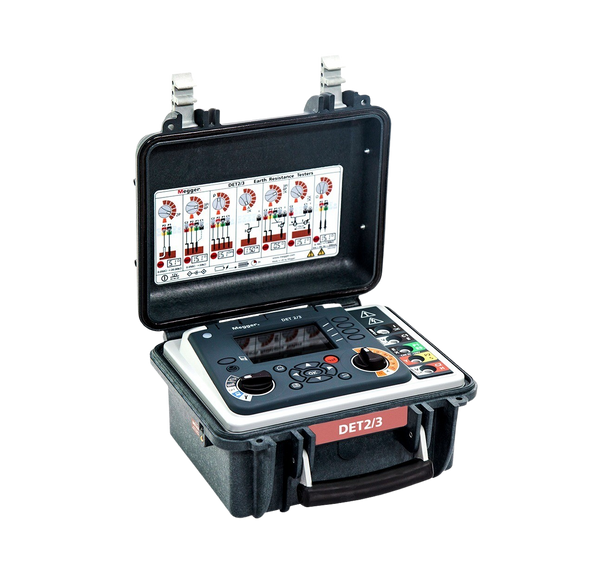
DET4 series four-terminal earth/ground resistance testers
About the product
Megger’s DET4 series of four-terminal earth/ground resistance testers offers a comprehensive solution to your earth/ground and soil resistivity testing needs.
To that end, this popular instrument series includes four models with different kit variants that contain various accessories for greater testing flexibility. The four basic units are:
- DET4TD2: Dry-cell battery-powered basic four-terminal tester
- DET4TR2: Rechargeable battery-powered basic four-terminal tester
- DET4TC2: Dry-cell battery-powered four-terminal tester with selectable test frequencies, greater measurement sensitivity, attached rod technique (ART), and stakeless measurement capability
- DET4TCR2: Rechargeable battery-powered four-terminal tester with selectable test frequencies, greater measurement sensitivity, attached rod technique (ART), and stakeless measurement capability
The DET4TC2 and the DET4TCR2 testers are for demanding applications requiring maximum versatility. These instruments support two-, three- and four-pole testing, as well as attached rod technique (ART), stakeless, leakage current, and earth noise voltage measurement. They also allow you to select the test frequency from one of four options: 94 Hz, 105 Hz, 111 Hz, and 128 Hz, making it easy to choose a frequency that minimises the effects of interference, even in difficult situations.
When the exceptional versatility of the DET4TC models is not needed, Megger offers the DET4TD2 and DET4TR2 testers, the former designed for use with replaceable batteries and the latter with rechargeable cells. These competitive instruments fully support the most popular earth resistance test methods – two-, three- and four-pole testing.
All DET4 models are rated to IP54, making them ideal for outdoor working, and they are designed to meet stringent safety standards, rated CAT IV to 100 V. Additionally, all the DET4 instruments are ergonomically designed with a large selector switch enabling you to easily select two, three, or four-pole tests, even with gloved hands.
My DET4 tester won’t turn on
Corrosion on the battery contacts is a frequent issue. This can be cleaned off and operation should be restored.
The display over ranges and constantly blinks. Rpx is also appearing in the lower left of the display
The PC board has two resistors on opposite sides of the orange relays that may fail. If P4 (four-terminal selector position) and P3 (three-terminal selector position) do not work but P2 (the two-terminal continuity position) does work, this is likely the problem. Please send it to a Megger Repair Centre.
I replaced the rechargeable battery in my DET4 with a 12 V throwaway. Now that I have returned a rechargeable battery to my DET4, it won’t charge
You can substitute a throwaway battery for the rechargeable one in DET4 models designated with R in their alpha-numeric designations. These testers recognise 9.6 V rechargeable batteries from 12 V throwaways. The tester will automatically disable the charging circuit if an attempt is made to charge a throwaway battery to prevent damage.
To enable the charging circuit again, you need to follow these steps:
- Switch the tester to 4P while holding down the TEST button. Software version # will briefly be displayed.
- The display will show ‘tst’; release TEST button.
- The Charger Enable Screen will be shown.
- The state of the charger circuit is shown by either a cross (X) or a tick (check mark) below the letters CHg. A cross indicates that the circuit is disabled.
- Re-enable the charger by pressing the TEST button once. The cross should change to a tick.
- Switch the DET4 off to save the new setting.
My earth/ground system is expansive, so I would need impractically long leads to make measurements in the usual way. What’s the alternative?
You can work with the test spikes at shorter distances from the earth/ground system using the slope test technique. With this technique, the current spike is inserted at an approximate distance of 2 to 3 times the maximum dimension of the earth/ground system. Measurements are then made with the voltage spike at 20 %, 40 %, and 60 % of the distance to the current spike. By using various criteria to evaluate the results obtained from these three tests and performing further tests, if necessary, you can obtain a reliable value for the resistance of the earthing system. Please see Megger’s “Getting Down to Earth” guide for further details.
What are the applications that require high-resolution measurements of earth/ground resistance?
In most cases, it is only necessary to show that the earth electrode resistance is below some specified maximum acceptable value. However, there are certain applications where high-resolution measurements are required. These include the determination of earth/ground resistance using the slope technique and evaluating earth/ground resistivity over large areas. High-resolution instruments typically use the four-terminal method of measurement and include additional features, such as variable test frequency, that help users to obtain good results even under challenging conditions.
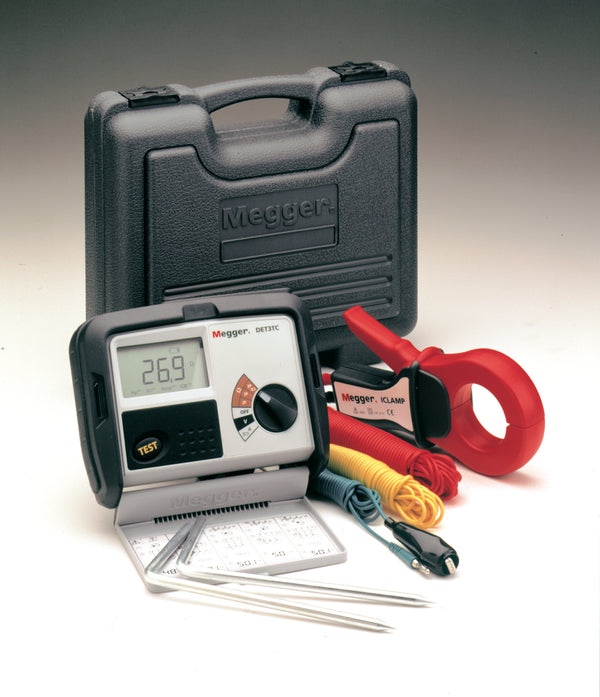
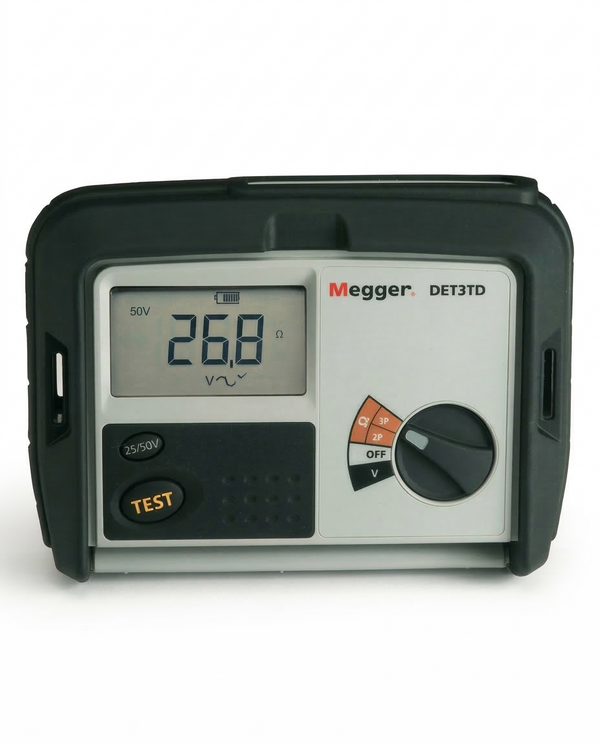
What are the benefits of a four-terminal earth resistance tester like the DET4 over a three-terminal earth resistance model like the DET3?
Four probes make a Kelvin bridge, which in grounding is only necessary for soil resistivity measurements. There has to be a uniform current across the sample of soil being measured, so you need two current probes and two potential probes, arranged C-P-P-C. Soil resistivity measurements can be used to establish the optimum electrode design and location, as well as for performing archaeological and geological investigations. For ground electrode testing, three terminals often suffice. Hence, a less expensive model is a smart choice if you are sure you will never need to perform soil resistivity testing. The exceptions are those cases when you need high-resolution earth resistance measurements (see the following FAQ).
Adding product to your cart