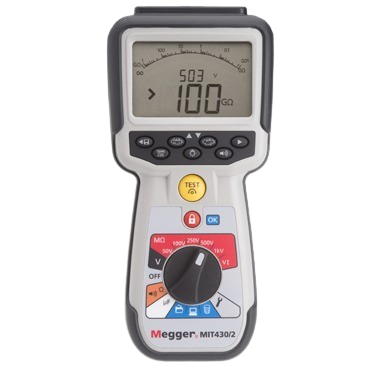
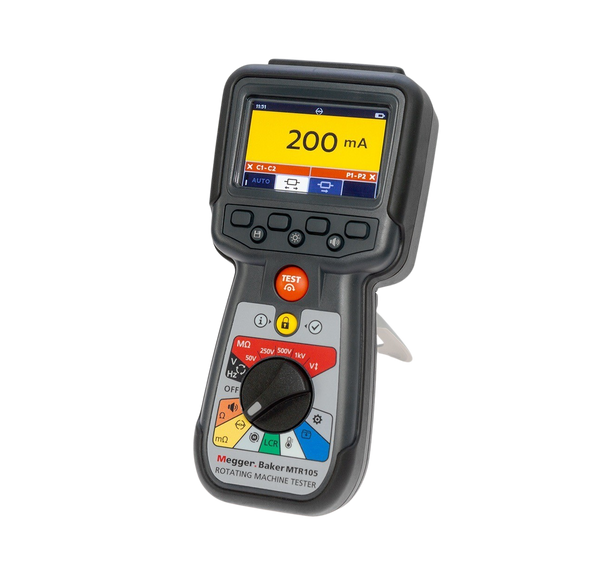
EVT100 Electric vehicle tester
The EVT100 has been designed to meet the needs of those who manufacture or maintain electric vehicles (EVs) and to aid compliance with the UNECE R100 regulations. A single compact handheld unit provides all the tests that these users will routinely need, including insulation resistance testing up to 1 kV, low-resistance bond testing, continuity and diode testing, and DC voltage measurement with polarity check.
Despite its versatility, the EVT100 is easy and safe to use, even for those with limited experience in electrical testing. It has a straightforward user interface and incorporates safety features that inhibit testing if it is not connected correctly or if an attempt is made to use it outside its operational range. Users also have access to detailed application guides and Megger’s renowned global support service.
To ensure reliable results, the EVT100 offers the option of two-, three- and four-wire low resistance testing, which can be used, for example, to verify the bonding of metal parts. The insulation resistance testing function offers automatic temperature compensation, and a guard terminal is provided to eliminate the effects of surface leakage, which could otherwise lead to inaccurate results.
To aid reporting, the EVT100 has internal storage for 256 test results. These can be easily downloaded via a standard USB memory stick and transferred to a computer for incorporation into reports and certificates. This not only saves time but also eliminates the risk of errors.
The EVT100 features rugged construction, ensuring a long, reliable operating life even in tough workshop conditions. It provides a comprehensive, reliable and easy-to-use solution for all EV and EV component testing requirements.
A warning message has appeared on the screen – what does it mean?
Any warning conditions while using the EVT100 will appear on the display with an error code. Screen instructions will guide you through the troubleshooting process.
If the instrument does not behave as normal and the warning messages do not disappear, the instrument has a fault and needs to be repaired.
Full details can be found in the instrument’s user guide, or by contacting our technical support lines. Below are the main warning messages and their meanings:
• Test failure - Lost connection
The EVT100 will notify you if the connection is lost during the test. You can re-establish the connection and then restart the test after a few seconds by pressing the test button or by reconnecting to a test piece.
• Failed export
The EVT100 will notify you if the export fails. This may be because the receiving USB device is faulty, disconnected, full, or fails in some other way.
The EVT100 will return to its previous screen.
• Fuse Failure
No measurements can be carried out if a fuse fails. A message will appear each time you try to run a test.
Close the message by pressing the tick/check button and refer to the user guide.
NOTE: A fuse failure warning could indicate a very low insulation resistance. Check the lead connection and try again.
• Battery Low
The battery is too low to perform a test. Please charge the batteries or replace them to continue using the instrument safely.
• Charging Fault
This is a generic charging fault warning screen.
Turn the instrument off and disconnect the charger. Then reconnect and try again.
• Battery not chargeable
The battery settings are not correct to allow battery charging.
Check that the correct battery type is in the instrument.
Check that the battery settings are for NiHM.
In either case, refer to the user guide for more information.
• Battery Charging Warning
Only NiHM battery cells are rechargeable. Do not attempt to recharge alkaline or lithium cells since that is a high-potential fire hazard.
If charging the EVT100 while the instrument is turned off, an animated battery will display across the screen to show charging is taking place. Once the battery is fully charged the screen will display a solid green battery.
• Code 1000 or higher
Follow the instructions on the screen, which will suggest rebooting the instrument. If the problem persists, contact Megger.
• The screen displays a “Voltage Detected” warning during a test.
Even if you don’t expect it, a voltage can be present or can develop during a test. The instrument will inhibit a test when the voltage detected exceeds dangerous limits, and will stop the test. This voltage threshold can be set as a lockout voltage.
The lockout voltage is active on all test modes. It is hard-coded to activate at 20 V. The only exception is the insulation resistance tests, where the lockout voltage can be set as 20 V, 30 V, 50 V, or 75 V.
Adding product to your cart